Feeding Automation: Benefits & Technologies
Why Manual Feeding Is Becoming Obsolete
On farms where feeding is still done manually, more than 30% of staff working time goes to this single operation. Dosing accuracy depends on the human factor, leading to uneven weight gains and feed waste. Automation solves both problems at once.
Types of Automated Feeding Systems
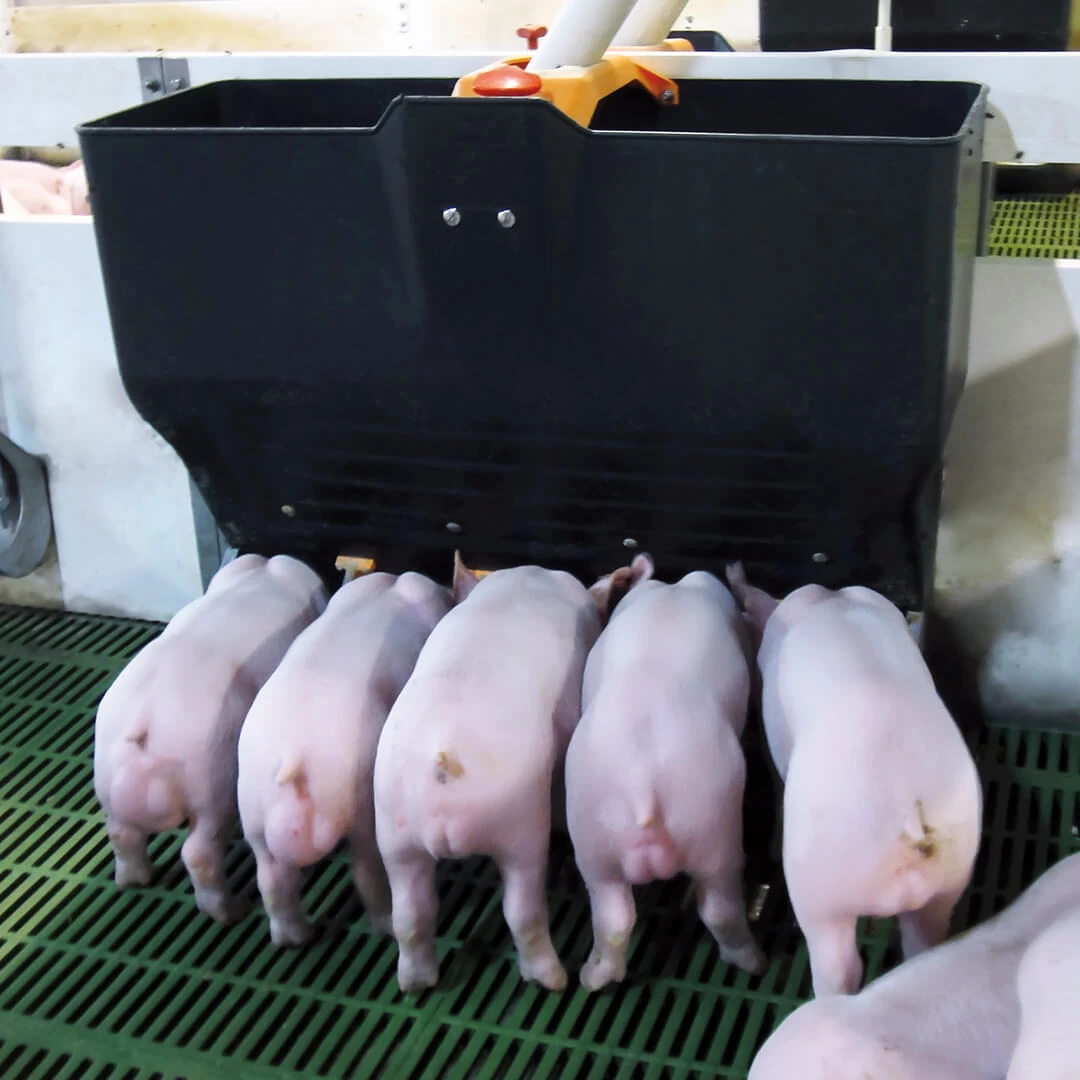
Dry Feeding (ad libitum) Hopper feeders with automatic dry feed delivery. Animals have free access to food. A simple-to-maintain solution for finishing sections, but less precise in consumption control.
Liquid Feeding Feed is mixed with water in set proportions and delivered via pipelines to each feeder. The system allows precise ration composition control for each section separately. Particularly effective when using liquid feed components and food industry by-products.
Electronic Sow Feeding (ESF) Used mainly for sows in group housing. Each animal is identified by chip at the feeding station entrance and receives a strictly individual portion. Enables real-time tracking of each animal's feed intake.
Key Benefits of Automation
Precise dosing reduces feed consumption by 10–15% — animals receive exactly what they need at each rearing stage. Feeding consistency ensures batch uniformity, which directly affects revenue at slaughter.
Reducing manual labour is not just about saving on staff costs — it also lowers stress for animals. A person in the building is always a source of excitement. Automatic scheduled feeding allows animals to adapt to a predictable routine.
Integration with Farm Management Software
Modern feeding systems integrate with farm management software. Feed consumption data for each section is available in real time via browser or mobile app. Any deviation from the norm — such as a sharp drop in consumption — is automatically flagged as a potential health warning.
Cost and Payback
The cost of a liquid feeding system for a 1,000-head farm starts at 400–600 thousand UAH depending on the manufacturer and configuration. With 12% feed savings and average consumption of 2.5 kg/day/head, the system pays back within 18–30 months.
Conclusion
Feeding automation is one of the fastest ways to reduce the cost of pork production. We select and install feeding systems tailored to the specific herd size, housing technology, and client budget.